Oh, Butoh…
Oh, Butoh…
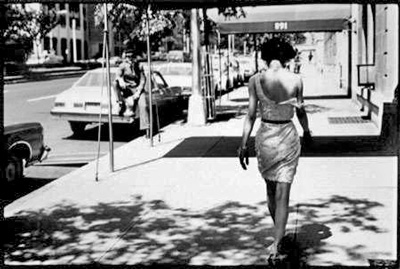
She worked in la Guerrero, a few streets down from Julian’s,
and she was 17 and had lost a son.
The memory made her cry in that Hotel Trebol room,
spacious and dark, with bath and bidet, the perfect place
to live out a few years. The perfect place to write
a book of apocryphal memories of a collection
of horror poem. Lupe
was thin and had legs long and spotted
like a leopard.
The first time I didn’t even get an erection:
and I didn’t want to have an erection. Lupe spoke of her life
and of what, for her, was happiness.
When a week had passed, we saw each other again. I found her
on a corner alongside other little teenage whores,
propped against the fender of an old Cadillac.
I think we were glad to see each other. From then on
Lupe began telling me things about her life, sometimes crying,
sometimes fucking, almost always naked in bed,
staring at the ceiling, hand in hand.
Her son was born sick and Lupe promised la Virgen
that she’d leave her trade if her baby was cured.
Soon after, her son died, and Lupe said the fault
was her own for not keeping up her bargain with la Virgen.
La Virgen carried off the little angel, payment for a broken
Promise.
I didn’t know what to say.
I liked children, sure,
but I still had many years before I’d know
what it was to have a son.
and so I stayed quiet and thought about the eerie feel
emerging from the silence of that hotel.
Either the walls were very thick or we were the sole
occupants
or the others didn’t open their mouths, not even to moan.
It was so easy to ride Lupe and feel like a man
and feel wretched. It was easy to get her
in your rhythm and it was easy to listen as she prattled on
about the latest horror films she’d seen
at Bucareli Theater.
Her leopard legs would wrap around my waist
and she’d sink her head into my chest, searching for my
nipples or my heartbeat.
This is the part of you I want to suck, she said to me
one night.
What, Lupe? Your heart.
Mmmmmmore cello…. Love this, by Adam Hurst.
Here’s a short clip of Henry Miller discussing the art in his bathroom and then some in his classic author’s voice.
Here is a contortion and body balancing act with a beautiful little edge::

From the window I saw the horses.
I was in Berlin, in winter. The light
had no light, the sky had no heaven.
The air was white like wet bread.
And from my window a vacant arena,
bitten by the teeth of winter.
Suddenly driven out by a man,
ten horses surged through the mist.
Like waves of fire, they flared forward
and to my eyes filled the whole world,
empty till then. Perfect, ablaze,
they were like ten gods with pure white hoofs,
with manes like a dream of salt.
Their rumps were worlds and oranges.
Their color was honey, amber, fire.
Their necks were towers
cut from the stone of pride,
and behind their transparent eyes
energy raged, like a prisoner.
There, in silence, at mid-day,
in that dirty, disordered winter,
those intense horses were the blood
the rhythm, the inciting treasure of life.
I looked. I looked and was reborn:
for there, unknowing, was the fountain,
the dance of gold, heaven
and the fire that lives in beauty.
I have forgotten that dark Berlin winter.
I will not forget the light of the horses.
are killing me right now. I just recently began taking cello lessons in another inspired attempt to become able to express my self musically, and as a result my friends have been sending me all sorts of cello youtube videos. The one below is my favorite, via Kawika.
This is Stjepan Hauser and Luka Sulic, quite young European cellists that have both been recognized and prized for their playing. I’m impressed and inspired. Here’s another one that’s a bit more tame but the interaction between the two of them makes me giddy.
Though this blog is typically all things art, I’m going to post something that’s a bit less… art… but more artful reality. The stuff art is made of, I suppose… Vulnerability.
Watch this TED Talk by Brene Brown.
(Via Jolie)
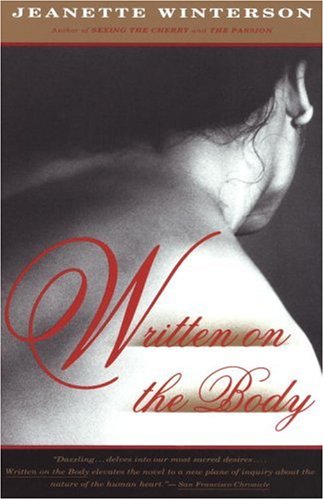
Jeanette Winterson’s novel “Written on the Body” is the first book I recommend when someone asks me for book ideas. I have my dear friend, KC, to thank for this one. This book is my go-to for poetic prose, the book I read over and over again, reference over and over again, because its language is so sweet and so desperately unforgiving.
The book is a genderless love story told from the point of view of the nameless author. The object of affection is Louise, a married woman.
“Written on the Body” is really more about savoring the words as opposed to a path to a dramatic ending. An exerpt:
Articulacy of fingers, the language of the deaf and dumb, signing on the body body longing. Who taught you to write in blood on my back? Who taught you to use your hands as branding irons? You have scored your name into my shoulders, referenced me with your mark. The pads of your fingers have become printing blocks, you tap a message on to my skin, tap meaning into my body. Your Morse code interferes with my heart beat. I had a steady heart before I met you, I relied upon it, it had seen active service and grown strong. Now you alter its pace with your own rhythm, you play upon me, drumming me taut.
Written on the body is a secret code only visible in certain lights; the accumulations of a lifetime gather there. In places the palimpsest is so heavily worked that the letters feel like Braille. I like to keep my body rolled up away from prying eyes. Never unfold too much, tell the whole story. I didn’t know that Louise would have reading hands. She has translated me into her own book.
To gaze at a river made of time and water
And remember Time is another river.
To know we stray like a river
and our faces vanish like water.
To feel that waking is another dream
that dreams of not dreaming and that the death
we fear in our bones is the death
that every night we call a dream.
To see in every day and year a symbol
of all the days of man and his years,
and convert the outrage of the years
into a music, a sound, and a symbol.
To see in death a dream, in the sunset
a golden sadness–such is poetry,
humble and immortal, poetry,
returning, like dawn and the sunset.
Sometimes at evening there’s a face
that sees us from the deeps of a mirror.
Art must be that sort of mirror,
disclosing to each of us his face.
They say Ulysses, wearied of wonders,
wept with love on seeing Ithaca,
humble and green. Art is that Ithaca,
a green eternity, not wonders.
Art is endless like a river flowing,
passing, yet remaining, a mirror to the same
inconstant Heraclitus, who is the same
and yet another, like the river flowing.
 Fierce:Fragile